

Why Employees Who Understand Their Debt Get More Done
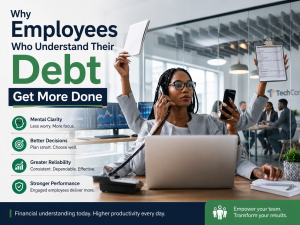 Financial stress is one of the most underestimated threats to productivity in today’s workplace. Organizations invest heavily in skills training, performance management systems, and employee engagement initiatives. Yet one powerful factor often goes unaddressed: employees’ personal debt.
When employees don’t understand their debt—how much they owe, how interest works, or how repayments are structured—it quietly undermines their focus, decision‑making, and performance. But when that understanding improves, the shift in productivity can be dramatic.
Debt Is More Than a Money Problem
Debt isn’t just a financial issue. It’s a cognitive and emotional burden.
Employees overwhelmed by unclear or poorly managed debt often carry constant anxiety into the workplace. Their mental energy is consumed by worries about repayments, growing interest, or calls from creditors. This mental load reduces concentration, increases mistakes, and leads to presenteeism—employees show up physically, but their minds are elsewhere.
No matter how skilled or experienced an employee is, it’s difficult to perform at their best when financial stress is running in the background all day.
Clarity Changes Everything
Understanding debt fundamentally changes this dynamic.
When employees gain basic financial literacy—particularly around how debt works—they move from a reactive mindset to a proactive one. Instead of feeling trapped, they start seeing structure. They can distinguish between good debt and bad debt, understand interest rates, repayment schedules, and the real consequences of default.
This clarity reduces uncertainty, which is one of the biggest drivers of stress. And when stress goes down, performance goes up.
More Mental Bandwidth, Better Focus
One of the most immediate benefits of debt understanding is reclaimed mental bandwidth.
When employees are no longer constantly worrying about their finances, they become more present at work. They can focus longer, think more clearly, and engage more deeply with their tasks. The energy previously spent on financial anxiety is redirected toward problem‑solving, creativity, and execution.
The result? Better quality work and improved efficiency.
Smarter Decisions—At Work and Beyond
Financial clarity also improves decision‑making.
Employees who understand their debt are less likely to act out of desperation. They’re less prone to impulsive choices such as taking repeated salary advances, engaging in risky side deals, or hopping from job to job in search of quick financial relief.
Instead, they begin thinking long‑term. They align career growth with financial goals, make more thoughtful professional decisions, and approach opportunities with greater stability and confidence.
Predictability at Home Creates Reliability at Work
Unmanaged debt often shows up at work as absenteeism, lateness, and disengagement. Employees dealing with urgent financial crises or aggressive debt collectors may miss work, arrive late, or struggle to stay engaged.
When employees understand their debt and have a clear repayment plan, these disruptions reduce significantly. Predictability in personal finances translates into reliability on the job.
Confidence, Control, and Engagement
There’s also a powerful psychological shift that comes with debt understanding: a sense of control.
Employees who feel in control of their finances tend to be more confident, motivated, and resilient. They’re more willing to take initiative, contribute ideas, and participate actively in teams. Financial stability creates emotional space for growth.
By contrast, employees under financial strain often withdraw. They avoid additional responsibilities, hesitate to speak up, and disengage—not because they lack ability, but because they’re overwhelmed.
The Ripple Effect on Teams and Culture
At an organizational level, the impact is clear.
Teams perform best when members are mentally present, dependable, and engaged. When financial stress affects a large portion of the workforce, collaboration suffers. Miscommunication increases, deadlines slip, and morale declines.
A financially informed workforce, however, supports stronger teamwork, better communication, and higher overall performance.
Reducing Ethical Risk Through Financial Literacy
There’s also a less comfortable but important reality: severe financial pressure can increase vulnerability to unethical behaviour. While not everyone under stress will act unethically, desperation raises risk.
By equipping employees with debt management knowledge, organizations indirectly reduce this risk. Financial clarity lowers desperation—and lower desperation reduces the likelihood of poor judgment.
Stronger Impact from Financial Wellness Programs
Employees who understand their debt are also more receptive to financial wellness initiatives.
Instead of viewing these programs as abstract or irrelevant, they recognize their practical value. Participation increases, engagement improves, and the return on investment for employers becomes more visible. Over time, this creates a healthier, more productive workforce.
Demystifying Debt Through Better Communication
Many employees avoid confronting their debt simply because they don’t understand it. Financial jargon, complex loan structures, and lack of guidance create barriers.
Organizations that simplify this information—through workshops, training sessions, or one‑on‑one counselling—make it easier for employees to engage constructively with their finances. Once debt is demystified, it becomes manageable.
A Long‑Term Cultural Shift
The long‑term impact of debt understanding is cultural.
When organizations prioritize financial literacy, they foster a culture of responsibility, openness, and stability. Employees support one another, share knowledge, and normalize conversations around money. Stigma reduces, and proactive behaviour becomes the norm.
The Bottom Line
When employees understand their debt, productivity doesn’t just improve—it becomes sustainable.
Reduced financial stress, increased clarity, and a sense of control create a workforce that is focused, reliable, and engaged. For organizations seeking real performance gains, investing in employee debt literacy isn’t just a welfare initiative. It’s a strategic business decision with measurable returns.
Build a more focused, productive workforce—starting with debt clarity.
Our Debt Literacy Training Program equips employees with practical skills to understand, manage, and reduce debt—lowering financial stress and improving performance at work. To enrol your team in debt literacy training write to us at info@debtorscare.co.ke